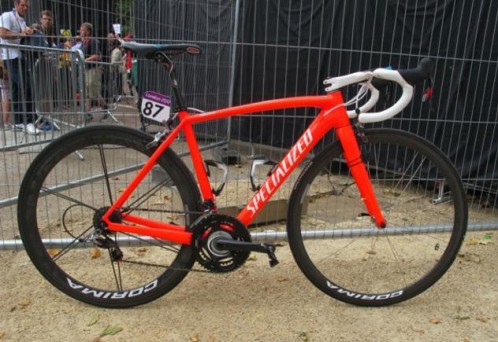
I definitely have a bit of Olympic fever, so I was up early on Saturday and Sunday to watch the London 2012 road races live (both really great races by the way). In the men’s and women’s pelotons, it was hard to miss the neon red Specializeds that were used by riders on teams sponsored by that brand. In their article about gold medalist Alexandre Vinokorouv’s Olympic Tarmac SL4, Bike Radar mentions that the bright color was Specialized’s way of branding their bikes in the peloton, while staying within the Olympic rules. They also point out that the IOC rules “specify exactly how tall each logo can be,” which explains why Vino’s bike and others looked almost retro now that we are all used to seeing pro bikes, and high-end road bikes in general, with many large logos and graphics on the frame, wheels, components, etc. At first glance, those Olympic Tarmacs reminded me of the S-Works E5 frames from around 2004. I really liked those bikes at the time with their nice, clean graphic scheme. Actually, I still own one, so apparently I still do like that simple single color paint scheme with limited branding.
Speaking of limited branding, you probably noticed the stealth black bikes used by the British men’s team (or most of them anyway) on Saturday. In his Bicycling Mag Boulder Report blog, Joe Lindsay fills us in on the story behind those logo-less bikes built by Advanced Composites Group, a “high-end composites that are used in Formula 1 racing, aerospace, and the America’s Cup sailboats.” Since UCI rules dictate that bikes used in competition must be available for sale to the public, you will be able to purchase a limited edition British Cycling frame soon for a LOT of money. Of course, the market value of those frames might have been much higher if the race on Saturday had gone as planned for Wiggins, Cavendish, and the GB team. Such is racing though…and did I already mention that it was a great one?
Update: More on the British team bikes here. Be sure to check out the detail shots of the crazy looking bar/stem combo. Yikes!


Leave a Reply