You are currently browsing comments. If you would like to return to the full story, you can read the full entry here: “An aerodynamic concept bike”.
Archives
Recent Comments
Recent Posts
Tags
Cannondale
carbon fiber
cargo bikes
China
city bike
Commuter
commuter bikes
commuter_bike_design_competiton
commuting
concept bike
design
design competition
E-bike
electric bikes
eurobike
fixie
folding bike
framebuilding
Greenville
HPV
Interbike
light
links
pro bikes
prototype
racing
reader submitted design
recumbent
rendering
road bike
road racing
Shimano
Specialized
Student Design
Taipei Cycle Show
Taiwan
time trial
Tour de France
tradeshow
trek
urban bikes
USA Cycling Championships
US Pro
velomobile
wooden bike


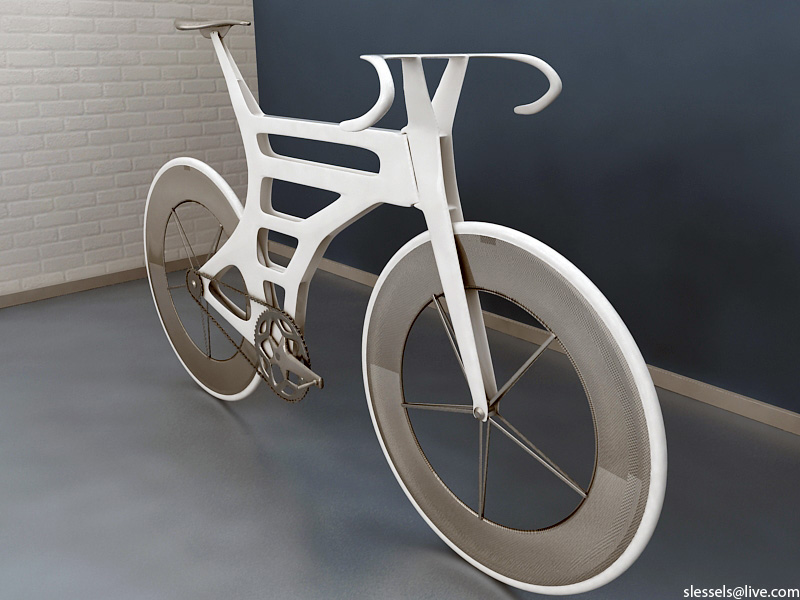
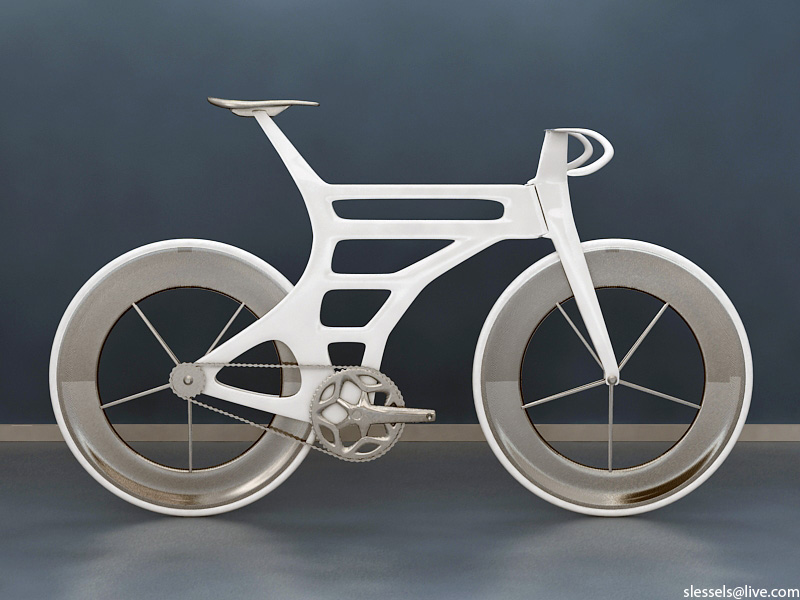
This better be a track-only bike… looks like a good sneeze could knock you sideways!
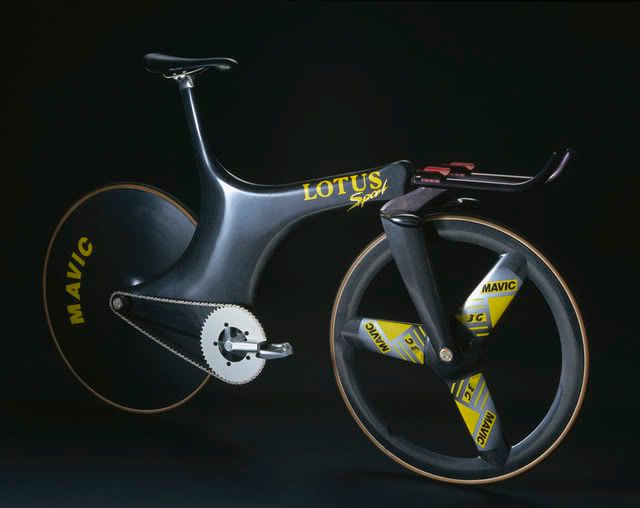
It certainly appears to be a track bike. At first glance, it reminded me of the old Lotus track bikes with the cog outside the frame.
I wonder why he chose this layout over something like a fully-faired recumbent or something like the Lotus bikes.
Those are speed holes. They make the car go faster.
It was in a Discover magazine many, many years ago, but there was a commercial introducing the world to “sky surfing” on snowboards (or similar), where the ride ended by parachute. It worked out that the drag of a flat board was better than a “swiss cheese” modification. I feel like this could happen again, except with two slippery fins having a compound effect by ramming so much air into a small central channel. Instead of being helpful, it could actually give the bike the drag profile of a single, less efficient foil.
Thanks Champs. I am certainly not an aerodynamics expert, but I also wondered about the airflow through of all of those intricate shapes that make up the frame. It seems like the intersecting airfoil shapes could create a lot of turbulence. I would like to read more about it… can you double-check your link? I would also be curios to see any research that Ess has done on the narrow twin airfoil shapes.
I’ve always wondered why designers work to reduce bike drag when the rider’s drag seems to be much greater, and it can’t be reduced much. Would a vented frame really pay off on the track?
Agreed, Billy T – the real innovation is when you incorporate features into the bike design that integrate with the rider to smooth out airflow. Certainly easier said than done, but also why Mike Burrows’ recumbent designs are so successful.
I do think that this is an interesting concept….not sure if it makes a great deal of structural sense (seems like it would be weakest laterally and stiffest vertically, which is not really what you want…), but at least it’s worth exploring.
I concur, aerodynamic bicycles are pointless exercises if the rider is ignored.
A single, mostly round, tube can hold a lot of force in any direction. This design has narrow tubes, which will result in a very flexible frame unless the tube walls are much thicker, adding a lot of weight. By trying to route air through the frame, it now has to hit more pieces in more places, causing turbulent air patterns which will hurt the aerodynamics.
Anyone want to take a stab at the rationale for the spoked wheels? Seems like they’d be pretty floppy with a hub flange that narrow, and I’m not sure why you wouldn’t just use a disc.
From what I can tell this guy is a furniture designer, not sure why he’s wasting time on trying to create an aero design without incorporating some engineering knowledge or computer modeling.
morning,
What kind of functional differences does placing the cog outside the frame produce? Why isn’t it done much right now? What impact does it have on the force distribution into the rear triangle?
Thank You,
Konstantin
I worked with the local university racing team optimizing aerodynamics for an open wheel race car and a UAV. These aren’t bikes, but I think I can say with 100% accuracy that this is a very poor aerodynamic design.
Framework for a bike with aerodynamics is necessary but what about the rider?. Unless he is paper thin………nothing is 100% dynamic